
Donkey Secondary Antibodies


Biotium HIF1α(HIF1A-84), CF647 conjugate, 0.1mg/mL
HIF1 (hypoxia-inducible factor 1), a heterodimeric transcription factor complex central to cellular response to hypoxia, consists of two subunits (HIF-1 alpha and HIF-1 beta) which are basic helix-loop-helix proteins of the PAS (Per, ARNT, Sim) family. Expression of HIF-1 alpha protein is regulated by cellular oxygen level alterations as well as in oxygen-independent manner via different cytokines (through the PI3K-AKT-mTOR pathway), growth factors, oncogenic activation, or loss of tumor suppressor function etc. In normoxic cells, HIF-1 alpha is proline hydroxylated leading to a conformational change that promotes its binding to the VLH (von Hippel Lindau) protein E3 ligase complex; ubiquitination and followed by rapid proteasomal degradation. Hypoxia as well as chemical hydroxylase inhibitors (desferrioxamine, cobalt etc.) inhibit HIF-1 alpha degradation and lead to its accumulation in the cells, whereas, contrastingly, HIF-1 beta/ARNT (AhR nuclear translocator) remains stab

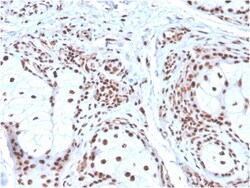
Biotium Nucleophosmin (Acute Myeloid Leukemia Marker)(NPM1/3286), CF647 conjugate, 0.1mg/mL
Recognizes a 33 kDa glycoprotein, identified as Nucleophosmin (NPM). It is predominantly localized in the nucleus of cells in most tissues. NPM is involved in ribosomal assembly and rRNA transport. It is an abundant protein that is highly phosphorylated by Cdc2 kinase during mitosis. This phosphoprotein moves between the nucleus and the cytoplasm. It is thought to be involved in several processes including regulation of the ARF/p53 pathway. A number of genes are fusion partners, in particular the anaplastic lymphoma kinase gene on chromosome 2. Mutations in exon 12 affecting the C-terminus of the protein are associated with an aberrant cytoplasmic location. Mutations in this gene are associated with acute myeloid leukemia. The antibody may be a useful aid for classification of acute myeloid leukemia. Primary antibodies are available purified, or with a selection of fluorescent CF Dyes and other labels. CF Dyes offer exceptional brightness and photostability. Note: Conjugat

Biotium CF633 Donkey Anti-Mouse IgG (H+L), Highly Cross-Adsorbed, 2 mg/mL
Fluorescently labeled Donkey Anti-Mouse IgG (H+L), Highly Cross-Adsorbed is prepared by labeling high quality antibody with a selection of fluorescent CF dyes and other labels. CF dyes are next-generation fluorescent dyes with advantages brightness, photostability, and conjugate specificity compared to other fluorescent dyes. Far-red fluorescent CF633 has excitation/emission at 630/650 nm. Supplied at 2 mg/mL in PBS, 50% glycerol, 2 mg/ml BSA, 0.05% sodium azide.
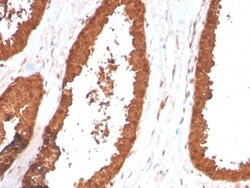
Biotium TIGIT / VSTM3 / VSIG9 (Immune Checkpoint for Cancer)(TIGIT/3017), CF647 conjugate, 0.1mg/mL
TIGIT is a checkpoint inhibitor which binds with high affinity to the poliovirus receptor (PVR), causing increased IL10 secretion, decreased IL12B secretion. TIGIT binding to PVR also causes the suppression of T cell activation by promoting the generation of mature immuno-regulatory dendritic cells. It is expressed at low levels on natural killer (NK) cells, as well as peripheral memory and regulatory CD4 T cells. At the protein level, it is upregulated following the activation of these cells. Functionally, TIGIT is similar to CTLA4. The ligands for TIGIT include CD155 (signal abrogation) and CD226 (signal stimulation). It has been demonstrated to be upregulated on T cells in many cancers and is an immuno-oncology target for therapy. Primary antibodies are available purified, or with a selection of fluorescent CF Dyes and other labels. CF Dyes offer exceptional brightness and photostability. Note: Conjugates of blue fluorescent dyes like CF405S and CF405M are not recomm
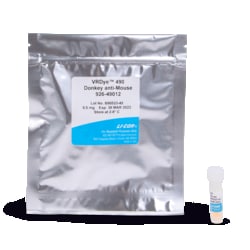
LICOR VRDye™ 490 Donkey anti-Mouse IgG Secondary Antibody (0.5 mg)
Immunogen: Mouse IgG | Applications: Western blotting | Formulation: VRDye 490 secondary antibodies are supplied as purified immunoglobulin conjugates, lyophilized in phosphate-buffered saline, pH 7.4. Protect from light. Store at 4 °C before and after reconstitution. Each vial contains 10 mg/mL BSA (free of IgG and protease) as a stabilizer and 0.01% sodium azide as a preservative, after reconstitution. Concentration is 1.0 mg/mL when reconstituted as directed. Refer to the pack insert for details on reconstitution.
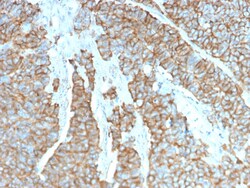
Biotium Drebrin 1 (DBN1)(DBN1/3393), CF647 conjugate, 0.1mg/mL
Drebrins (developmentally regulated brain proteins) are cytoplasmic proteins that bind F-actin in the brain and are involved in cell migration, extension of neuronal processes and plasticity of dendrites. There are three isoforms: two embryonic types (E1 and E2); and an adult type (A), generated by alternative RNA splicing from a single Drebrin gene. Drebrins are expressed mainly in brain neurons but are also found in skeletal muscle, heart, placenta, pancreas and kidney. Drebrin has been designated as a marker of the dendritic spine. Decreases in Drebrin levels in the brain have been been associated with Alzheimer's disease and Down syndrome. Primary antibodies are available purified, or with a selection of fluorescent CF Dyes and other labels. CF Dyes offer exceptional brightness and photostability. Note: Conjugates of blue fluorescent dyes like CF405S and CF405M are not recommended for detecting low abundance targets, because blue dyes have lower fluorescence and can

Electron Microscopy Sciences Aurion ImmunoGold Donkey-Anti-Mouse, IgG, EM-grade 6nm 2.5 ML
It is impossible to perform a double labeling experiment in combination with, for instance a mouse primary antibody, since applicable secondary antibodies are either raised in rabbit or goat. To overcome this difficulty the Aurion Series of Secondary ImmunoGold conjugates is based on antibodies raised in Donkey, including Donkey-anti-Goat. It is then known that mixing Donkey-anti-Goat and Donkey-anti-Mouse provides a successful solution.
Particle size: EM-grade 6nm
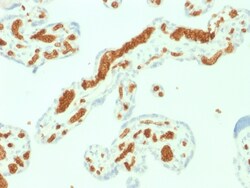
Biotium Spectrin Alpha 1 (Erythrocyte Marker) (SPTA1/1832), CF647 conjugate, 0.1mg/mL
Spectrin is an actin crosslinking and molecular scaffold protein that links the plasma membrane to the actin cytoskeleton, and functions in the determination of cell shape, arrangement of transmembrane proteins, and organization of organelles. Spectrins function as membrane organizers and stabilizers, composed of non-homologous α andβ chains, which aggregate side-to-side in an anti-parallel fashion to form dimers, tetramers and higher polymers. Spectrin α I and spectrinβ I are present in erythrocytes, whereas spectrin α II (also designated fodrin α) and spectrinβ II (also designated fodrinβ) are present in other somatic cells. The spectrin tetramers in erythrocytes act as barriers to lateral diffusion, but spectrin dimers seem to lack this function.Primary antibodies are available purified, or with a selection of fluorescent CF Dyes and other labels. CF Dyes offer exceptional brightness and photostability. Note: Conjugates of blu
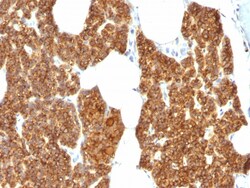
Biotium Parathyroid Hormone (PTH) (N-Terminal), CF647 conjugate, 0.1mg/mL
Epitope of this PAb maps in the N-terminus of PTH, a hormone produced by the parathyroid gland that regulates the concentration of calcium and phosphorus in extracellular fluid. This hormone elevates blood Ca2 levels by dissolving the salts in bone and preventing their renal excretion. It is produced in the parathyroid gland as an 84 amino acid single chain polypeptide. It can also be secreted as N-terminal truncated fragments or C-terminal fragments after intracellular degradation, as in case of hypercalcemia. Defects in this gene are a cause of familial isolated hypoparathyroidism (FIH); also called autosomal dominant hypoparathyroidism or autosomal dominant hypocalcemia. FIH is characterized by hypocalcemia and hyperphosphatemia due to inadequate secretion of parathyroid hormone. Symptoms are seizures, tetany and cramps. FIH exist both as autosomal dominant and recessive forms of hypoparathyroidism. Primary antibodies are available purified, or with a selection of fluores
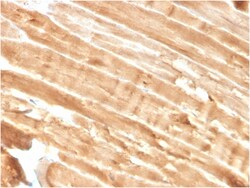
Biotium Dystrophin (DMD) (Marker of Duchenne and Becker Muscular Dystrophy)(DMD/3244), CF647 conjugate, 0.1mg/mL
Dystrophin-glycoprotein complex (DGC) connects the F-Actin cytoskeleton on the inner surface of muscle fibers to the surrounding extracellular matrix, through the cell membrane interface. A deficiency in this protein contributes to Duchenne (DMD) and Becker (BMD) muscular dystrophies. The human dystrophin gene measures 2. 4 megabases, has more than 80 exons, produces a 14 kb mRNA and contains at least 8 independent tissue-specific promoters and 2 poly A sites. The dystrophin mRNA can undergo differential splicing and produce a range of transcripts that encode a large set of proteins. Dystrophin represents approximately 0. 002% of total striated muscle protein and localizes to triadic junctions in skeletal muscle, where it is thought to influence calcium ion homeostasis and force transmission. Primary antibodies are available purified, or with a selection of fluorescent CF Dyes and other labels. CF Dyes offer exceptional brightness and photostability. Note: Conjugates of bl
Biotium Connexin 32 (Gap Junction Protein) (R5.21C), CF647 conjugate, 0.1mg/mL
This antibody recognizes a protein of 27-32 kDa, identified as Connexin 32. The connexin family of proteins forms hexameric complexes called connexons that facilitate movement of low molecular weight proteins between cells via gap junctions. Connexin proteins share a common topology of four transmembrane alphalpha-helicaldomains, two extracellular loops, a cytoplasmic loop and cytoplasmic N- and C-termini. Many of the key functional differences arise from specific amino-acid substitutions in the most highly conserved domains, the transmembrane and extracellular regions. Each of the approximately 20-connexin isoforms produces channels with distinct permeability and electrical and chemical sensitivities; therefore, one connexin usually cannot fully substitute for another.Primary antibodies are available purified, or with a selection of fluorescent CF Dyes and other labels. CF Dyes offer exceptional brightness and photostability. Note: Conjugates of blue fluorescent dyes like
Immunoreagents Inc DONKEY A-MOUSE IGG BIO
Secondary Antibody; Donkey anti-mouse IgG (H&L) - F(ab)'2 fragment, min x w/Bo, Ck, Eq, Gt, Gp, Ha, Hu, Rb, Rt or Sh IgG, Biotin Conjugate, Host: Donkey, Format: Liq, Label: Biotin, Applications: WB, ELISA, IHC/ICC
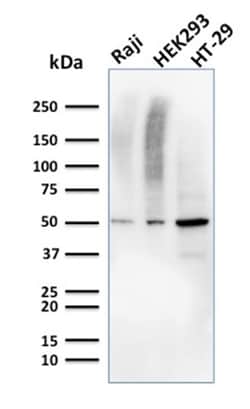
Biotium MMP3 (Marker of Metastasis and Rheumatoid Arthritis)(MMP3/2655), CF647 conjugate, 0.1mg/mL
The matrix metalloproteinases (MMP) are a family of peptidase enzymes responsible for the degradation of extracellular matrix components, including collagen, gelatin, fibronectin, laminin and proteoglycan. Transcription of MMP genes is differentially activated by phorbol ester, lipopolysaccharide (LPS) or staphylococcal enterotoxin B (SEB). MMP catalysis requires both calcium and zinc. MMP-3, MMP-10 and MMP-11 (also designated stromelysin-1, 2 and 3, respectively) activate procollagenase. MMP-3 activation of procollagenase can occur via two pathways. Direct activation by MMP-3 is slow and activation by MMP-3 in conjunction with tissue or plasma proteinases is rapid. MMP-10 is expressed in small intestine, and at lower levels in lung and heart. MMP-11 is specifically expressed in stromal cells of breast carcinomas and contributes to epithelial cell malignancies. Primary antibodies are available purified, or with a selection of fluorescent CF Dyes and other labels. CF Dyes of
Immunoreagents Inc DONKEY A-MOUSE IGG ALP
Secondary Antibody; Donkey anti-mouse IgG (H&L) - F(ab)'2 fragment, min x w/Bo, Ck, Eq, Gt, Gp, Ha, Hu, Rb, Rt or Sh IgG, ALP Conjugate, Host: Donkey, Format: Liq, Label: ALP, Applications: WB, ELISA